
Does Wool Bedding Keep You Cool? The Science of Thermoregulation
Yes. Wool bedding actively regulates your body temperature by absorbing up to 35% of its weight in moisture vapour and releasing heat through evaporation - a cycle that polyester, down, and cotton cannot replicate. A 2026 Bangor University study found wool duvets transmitted up to 139% more moisture than synthetic alternatives at elevated temperatures, while maintaining 22°C at the duvet centre overnight compared to just 13–15°C for other materials. Wisewool™ uses New Zealand strong wool, which has thicker fibres and greater natural crimp than merino, creating superior airflow in bedding and mattress applications.
How does wool compare to synthetic and down bedding for temperature regulation?
Wool outperforms every common bedding material on the metrics that matter for thermoregulation. The table below compiles data from six independent institutions.
| Property | NZ Strong Wool | Polyester | Down/Feather | Cotton | Source |
|---|---|---|---|---|---|
| Moisture absorption (% of fibre weight) | Up to 30–35% | <1% | 5–8% | 7–10% | CSIRO; AgResearch NZ |
| Moisture transmission at elevated temp. | Up to 139% more than synthetic | Baseline (condensation formed inside duvet) | Wool 151% more | Not tested | Bangor University / British Wool / IWTO (2026) |
| Insulation vs synthetic duvet | 25% better | Baseline | Wool 30% better than F/D; 17% better than pure down | Not tested | Bangor University / British Wool / IWTO (2026) |
| Overnight temp. stability (8hr test) | 22°C at duvet centre; only 20% heat loss bottom-to-middle | 13–15°C; 34–47% heat loss | 13–15°C; 34–47% heat loss | Not tested | Bangor University / British Wool / IWTO (2026) |
| Sleep onset (older adults ≥65, 30°C, sleepwear) | 12.4 min | 21.6 min | Not tested | 26.7 min | Univ. of Sydney (Chow et al., 2019) |
| Moisture buffering vs polyester (next-to-skin) | 96% superior (merino wool) | Baseline | Not tested | Not tested | Woolmark / AWI / NC State (pub. IWTO, 2025) — sports study |
Table: Thermoregulation performance comparison — compiled from six independent institutional sources. All numbers verified against primary publications.
Why does wool regulate temperature better than synthetic materials?
Wool regulates temperature because its keratin fibres actively absorb and release moisture vapour in response to changes in humidity and body heat. This is not passive insulation, it is an active thermoregulatory cycle. When your body temperature rises during sleep, wool absorbs the moisture vapour your skin produces and releases it through evaporation, pulling heat away from the sleep microclimate.
Polyester absorbs less than 1% of its weight in moisture, which means your sweat has nowhere to go. It sits on the surface, humidity builds up between you and the covers, and that’s what wakes you at 3 am. Down performs better than polyester but still absorbs only 5–8% of its weight. Wool’s 35% absorption capacity operates in a different league entirely.
What did the 2026 Bangor University study find about wool duvets?
The 2026 Bangor University study, conducted at the BioComposites Centre in partnership with British Wool and IWTO and funded by the Welsh Government, tested full-sized single duvets of similar tog ratings (10–10.5) against synthetic, feather/down, and pure down alternatives. Wool provided 25% better insulation than synthetic and 30% better than feather/down. At elevated temperatures, simulating a hot sleeper or warm bedroom, wool transmitted up to 139% more moisture than synthetic and 151% more than feather/down.
In the eight-hour overnight temperature test, wool maintained 22°C at the duvet centre with only 20% heat loss from bottom to middle. Synthetic and feather/down alternatives measured just 13–15°C with 34–47% heat loss across the same zones. That thermal stability is the difference between deep, uninterrupted sleep and the cycle of overheating, kicking off the covers and waking cold an hour later.
Notably, during the elevated temperature test, condensation was reported to have formed inside the synthetic duvet and dripped back into the test bath - a physical illustration of what the moisture transmission data confirms: synthetic material traps vapour rather than passing it through.
Does wool bedding help you fall asleep faster?
A University of Sydney study (Chow et al., 2019, published in Nature and Science of Sleep) tested cotton, polyester, and merino wool sleepwear on 36 adults aged 50–70 in warm conditions (30°C, 50% relative humidity). Among older participants (≥65), those wearing wool fell asleep in 12.4 minutes, compared to 21.6 minutes in polyester and 26.7 minutes in cotton. Wool also reduced the sleep fragmentation index compared to polyester (p=0.005), meaning fewer wake-ups through the night.
The mechanism is thermoregulatory: wool draws moisture and heat away from the skin surface, lowering core body temperature faster, which is the physiological trigger for sleep onset. The same principle applies to wool bedding, where the sleep microclimate (the zone between your body and your covers) determines how quickly you transition from wakefulness to sleep. It is worth noting this study tested sleepwear, not bedding directly, but the underlying fibre science is identical.
"The study was funded by Australian Wool Innovation and conducted by University of Sydney researchers."
Is wool bedding suitable for hot sleepers and warm climates?
Wool is one of the most effective bedding materials for hot sleepers and tropical climates. Wool in hot weather sounds counterintuitive - until you look at what’s actually happening at the fibre level. Wool does not simply trap heat like synthetic insulation. It actively manages humidity, which is the primary cause of sleep disruption in warm conditions.
Wisewool™ supplies WiseLayer™ to mattress makers across Southeast Asia - Indonesia, Thailand, Vietnam - where night temperatures sit above 28°C for months at a time. These manufacturers chose wool over synthetic specifically because it performs in sustained heat.
The Bangor University data confirms this: wool’s moisture transmission advantage increases at elevated temperatures, widening the performance gap over synthetic and down. At elevated temperatures, condensation formed inside the synthetic duvet while wool showed none.
What makes New Zealand strong wool different for sleep?
New Zealand produces two types of wool: fine merino (approximately 10% of production) and strong crossbred wool (approximately 90%). Strong wool, in the 31–40 micron range, has thicker fibres with greater natural crimp than merino. In non-woven bedding applications like mattress layers and duvet fills, this translates to superior compressional resilience and better airflow between fibres.
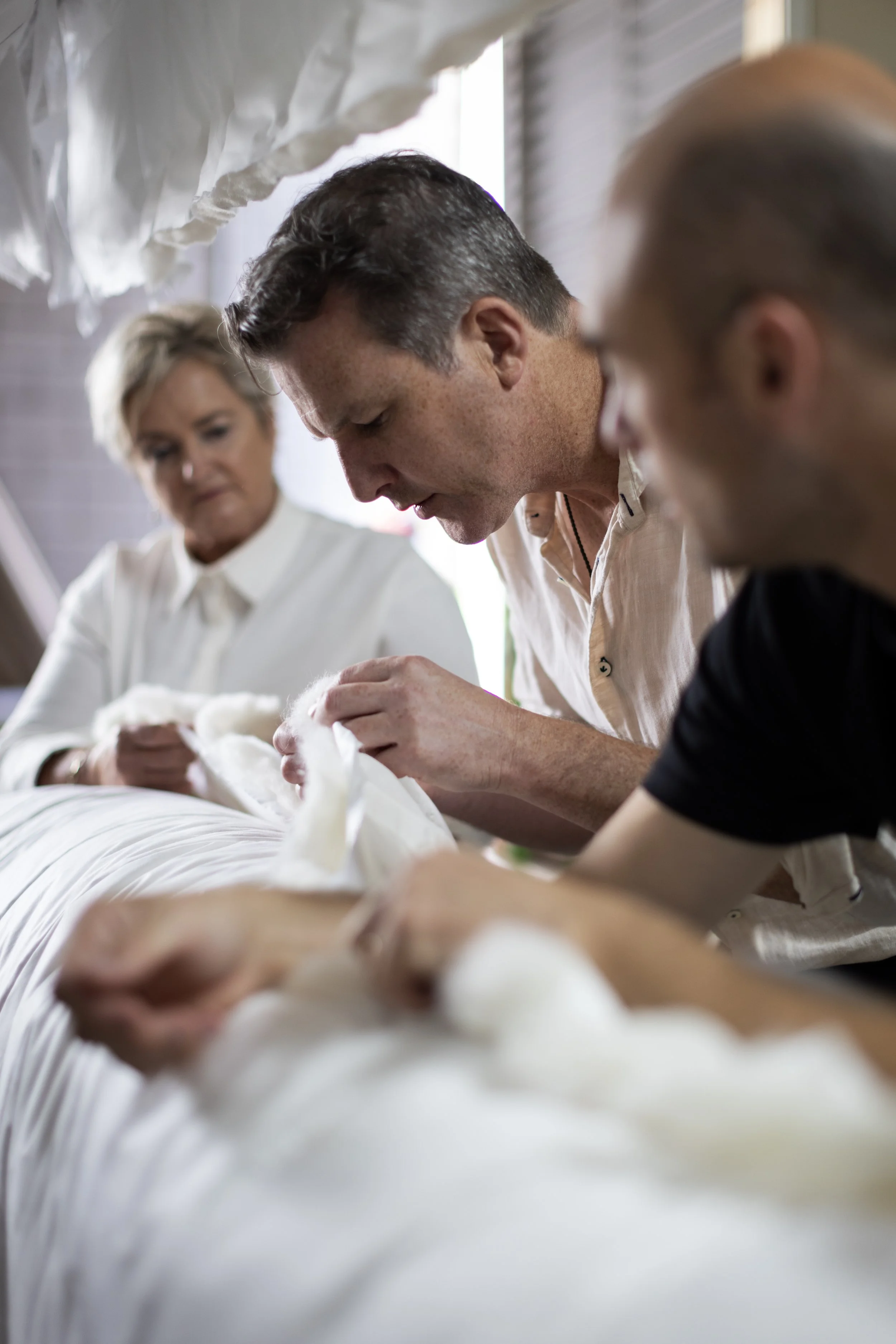
Wisewool™ manufactures WiseLayer™ (needle-punched wool batting from 200gsm to 1000gsm+) and WiseFill™ (loose wool fill) from 100% New Zealand strong wool sourced from 250+ farming families in the Gisborne/Tairāwhiti region. The company has handled wool for five generations since 1894 and is currently conducting a three-year MPI-funded sleep science study (PSGF-251969) that runs real-life and clinical trials concurrently. By measuring wool's thermoregulatory effects both in participants' own homes and under rigorous clinical polysomnography conditions, the study is designed to produce a level of evidence - ecologically valid and scientifically controlled - that has not previously existed in wool sleep science.
What is the sleep microclimate and why does it matter?
The sleep microclimate is the thin zone of air between your body and your bedding. Temperature and humidity in this zone determine whether you sleep through the night or wake up overheating. Maintaining a stable temperature with low relative humidity in this zone is the critical factor for uninterrupted sleep.
The 2026 study by British Wool, IWTO, and the BioComposites Centre at Bangor University demonstrated the thermal performance differences between filling materials directly: wool maintained 22°C at the duvet centre over an eight-hour test, compared to just 13–15°C for synthetic, feather/down, and pure down alternatives. Wool lost only 20% of its heat from the bottom to the middle, compared to 34–47% in the other materials. Wool's hygroscopic fibre structure absorbs and releases moisture vapour rather than allowing it to condense - making it uniquely effective at maintaining stable microclimate conditions compared to the synthetic and down alternatives tested.
Key takeaway
Wool bedding actively regulates temperature through moisture absorption and evaporative heat release - a mechanism no synthetic material can replicate. Data from Bangor University, the University of Sydney, CSIRO, and Woolmark/NC State consistently shows wool outperforms polyester, down and cotton on every thermoregulation metric relevant to sleep. For hot sleepers, menopausal women, and anyone in warm climates, wool is the most effective bedding material available.
References
Bangor University BioComposites Centre / British Wool / IWTO (2026). Performance Analysis of Wool Bedding: Thermal Insulation and Moisture Management. Funded by Welsh Government.
Chow, C.M., Shin, M., Mahar, T.J., Halaki, M. & Ireland, A. (2019). The Impact of Sleepwear Fiber Type on Sleep Quality Under Warm Ambient Conditions. Nature and Science of Sleep, 11, 167–178. Funded by Australian Wool Innovation.
CSIRO, Australia (various). Hygroscopic Properties of Natural Fibres in Textile Applications. Commonwealth Scientific and Industrial Research Organisation.
Woolmark / NC State University (2025). Dynamic Breathability and Moisture Buffering of Merino Wool in Active Garments. Four-year PhD research programme. Note: sports/activewear study, cited for general wool fibre properties.
AgResearch New Zealand (various). Physical and Mechanical Properties of New Zealand Crossbred Wool Fibres.
Wisewool™ / Ministry for Primary Industries (2024). Compressional Resilience of New Zealand Strong Wool in Non-Woven Bedding Applications. PSGF Study.
AUTHOR BIO
Harry Urquhart-Hay is Co-Founder of Wisewool™, a fifth-generation New Zealand strong wool company. Wisewool™ controls the wool journey from 250+ partner farms in Gisborne through to finished product, and is currently conducting a three-year MPI-funded clinical sleep science study.