Wool vs Polyester vs Down for Sleep: The Complete Comparison
Wool vs Polyester vs Down for Sleep: The Complete Comparison
Wool outperforms polyester, down and foam across every metric that determines sleep quality. Independent testing by SATRA (UK) and NZWTA (New Zealand) confirms Wisewool™ wool batting retains approximately 95% of its thickness after 80,000 pounding cycles, while polyester lost over half its hardness in the same test. A 2026 Bangor University study found wool duvets transmitted 139% more moisture than synthetic alternatives at elevated temperatures, where condensation actually formed inside the polyester duvet.
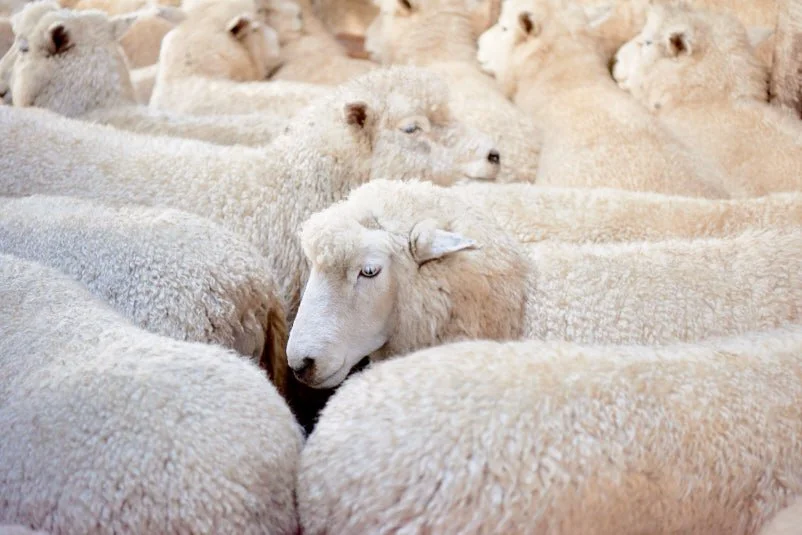
How do wool, polyester, DOWN, and foam compare for bedding?
The table below compiles data from eight independent institutions and accredited laboratories across four countries. Every number has a named source and test method.
| Property | NZ Strong Wool | Polyester | Down / Feather | Foam | Source |
|---|---|---|---|---|---|
| Moisture absorption (% of fibre weight) | Up to 35% without feeling wet | <1% | 5–8% | <1% (closed-cell) | CSIRO; AgResearch NZ |
| Moisture transmission at elevated temp. | 139% more | Baseline (condensation formed inside duvet) | Wool 151% more | Not tested | Bangor / IWTO (2026) |
| Insulation vs synthetic duvet | 25% better | Baseline | Wool 30% better than F/D; 17% better than pure down | High but traps body heat | Bangor / IWTO (2026) |
| Overnight temp. stability (8hr test) | 22°C at duvet centre; 20% heat loss bottom-to-middle | 13–15°C; 34–47% heat loss | 13–15°C; 34–47% heat loss | Not tested | Bangor / IWTO (2026) |
| Moisture buffering vs polyester (next-to-skin) | 96% superior (merino) | Baseline | Not tested | Not tested | Woolmark / NC State (2025) — sports study |
| Sleep onset (older adults ≥65, 30°C, sleepwear) | 12.4 min | 21.6 min | Not tested | Not tested | Univ. of Sydney (Chow et al., 2019) |
| Thickness retention after 80,000 cycles (6hr recovery) | ~95% (WiseLayer™) | ~87% | Not tested | ~97% | SATRA, UK (EN ISO 3385:2014) Ref: FUR0344456 |
| Hardness retention after 80,000 cycles (6hr recovery) | ~68% (WiseLayer™) | ~48% | Not tested | ~70% | SATRA, UK (EN ISO 2439:2008) Ref: FUR0344456 |
| Fire: cigarette test (BS 5852 Pt1) | PASS | PASS | Not tested | PASS | NZWTA (BS 5852:1979) Cert: 1446262 |
| Fire: open flame (BS 5852 Pt2) | PASS | FAIL — unsafe escalating combustion; sample extinguished | Not tested | FAIL — unsafe escalating combustion; sample extinguished | NZWTA (BS 5852:1982) Cert: 1446262 |
| Chemical FR required? | No — naturally fire retardant | Yes | Yes | Yes | NZWTA fire test results |
| Pesticide / chemical residue | Not detected — all categories (nd) | N/A (synthetic) | Varies by source | N/A (synthetic) | NZWTA (IWTO-DTM-59) 2023 |
| Biodegradation | 3–6 months in soil | 200+ years | 3–6 months | 200+ years | Published materials science |
| Microplastic shedding | None | Yes — every wash | None | Yes — petroleum-derived | Published environmental research |
Table: Bedding material comparison for sleep — 14 metrics, 8 institutional sources, 4 countries. Every number verified against primary source.
Which bedding material manages moisture best during sleep?
Wool absorbs up to 35% of its weight in moisture vapour without feeling wet - more than any other common bedding fibre (CSIRO; AgResearch NZ). Polyester and foam absorb less than 1%. The 2026 Bangor University study, conducted at the BioComposites Centre in partnership with IWTO and funded by the Welsh Government, tested full-sized duvets of similar tog ratings under controlled conditions. At elevated temperatures simulating increased perspiration, wool transmitted 139% more moisture than the synthetic duvet and 151% more than feather and down.
The most striking finding: during the high-temperature test, condensation formed inside the synthetic duvet and dripped back into the test bath. This is the mechanism behind that 3 am clammy-sheets wake-up. Wool’s hygroscopic keratin structure prevents this entirely - moisture vapour passes through the fibre, not around it.
Does wool bedding keep you cooler than polyester and down?
Yes. In the Bangor study’s eight-hour overnight temperature test, wool maintained a centre temperature of 22°C with only 20% heat loss from the duvet’s bottom layer to its middle. Synthetic and feather/down alternatives measured 13–15°C with 34–47% heat loss across the same zones. Wool provided 25% better insulation than synthetic, 30% better than feather/down, and 17% better than pure down. Foam presents a different problem: it insulates well but traps body heat against the skin, creating hotspots that synthetic cooling gels only partially address.
Does wool help you fall asleep faster?
A University of Sydney study (Chow et al., 2019, published in Nature and Science of Sleep) conducted a sleepwear study and tested cotton, polyester, and merino wool sleepwear on 36 adults aged 50–70 in warm conditions (30°C, 50% RH). Among older participants (≥65), those wearing wool fell asleep in 12.4 minutes, compared to 21.6 minutes in polyester and 26.7 minutes in cotton. The study also found wool reduced the sleep fragmentation index compared to polyester (p=0.005), meaning fewer wake-ups through the night. The mechanism is thermoregulatory: wool draws moisture and heat from the skin surface, lowering core body temperature faster, which is the physiological trigger for sleep onset.
How does wool compare on durability and compression recovery?
SATRA Technology Centre (UK), a UKAS-accredited laboratory, subjected Wisewool™ WiseLayer™ wool batting, polyester fill, and foam to 80,000 pounding cycles under EN ISO 3385:2014 and EN ISO 2439:2008. After six hours of recovery - simulating overnight rest between use - WiseLayer™ retained approximately 95% of its original thickness, comparable to foam at approximately 97%. Polyester retained approximately 87%.
Hardness tells a sharper story. WiseLayer™ retained approximately 68% of its original hardness. Foam retained approximately 70%. Polyester retained just 48% - losing over half its support. The SATRA report, prepared by Professor Emeritus Raechel Laing and Dr Cheryl Wilson, concluded that WiseLayer™ and foam performed similarly. But foam matched wool on compression alone. On every other metric - moisture, fire safety, chemical content, biodegradability - wool is the superior material.
Is wool bedding safer than polyester and foam in a fire?
NZWTA (New Zealand Wool Testing Authority), an independent accredited laboratory, tested Wisewool™ WiseLayer and WiseFill against foam chips and polyester fill under BS 5852 - the international standard for upholstered furniture fill flammability. Both wool products passed the smouldering cigarette test (Part 1) and the butane open-flame test (Part 2). Both foam and polyester passed the cigarette test but failed the open-flame test. The failure mode in both cases was classified as “unsafe escalating combustion” - the samples had to be physically extinguished by laboratory staff to prevent uncontrolled fire.
Wool achieved this with zero chemical flame-retardant treatment. Separate NZWTA pesticide residue testing (IWTO-DTM-59) found zero detectable chemical residues in Wisewool™ wool across all categories: organochlorines, organophosphates, synthetic pyrethroids, and insect growth regulators. Every result was “nd” (not detected). For anyone concerned about chemical exposure in the bedroom - particularly for children’s bedding - this combination of natural fire resistance and chemical purity is unmatched.
Which bedding material is most sustainable?
Wool biodegrades in soil within 6-12 months. Polyester and foam take hundreds of years. Wool sheds zero microplastics; polyester releases microplastic fibres with every wash. Wool is a renewable resource - sheep regrow their fleece annually - and absorbs volatile organic compounds from indoor air rather than emitting them. Even “recycled polyester” bedding still sheds microplastics and still takes centuries to decompose.
Why does Wisewool™ use New Zealand strong wool instead of merino?
New Zealand produces approximately 90% strong crossbred wool (31–40 micron) and 10% fine merino. Strong wool’s thicker fibre and greater natural crimp give it superior compressional resilience in non-woven batting - exactly what the SATRA testing confirmed. Merino excels next-to-skin in clothing; strong wool excels under sustained load in bedding and mattresses. Wisewool™ manufactures WiseLayer™ (needle-punched batting, 200gsm to 1000gsm+) and WiseFill™ (loose wool fill) from 100% New Zealand strong wool sourced from 250+ farming families in the Gisborne/Tairāwhiti region, with full traceability through WiseTrace™.
Key takeaway
Wool outperforms polyester, down, and foam on thermoregulation, durability, fire safety, chemical purity, and environmental impact. This is not one study - it is consistent evidence across eight institutions and accredited laboratories in four countries, using six different internationally recognised test methods. Wisewool™’s New Zealand strong wool adds independently verified compressional resilience, fire safety, and farm-to-product traceability that no other wool bedding source can match.
References
1. SATRA Technology Centre, UK (2023). Hardness and Pounding Recovery Testing: Wisewool Products vs Commercial Fill. Reference: FUR0344456 2307, Report IDs: 27253–27257. Tested to EN ISO 2439:2008 and EN ISO 3385:2014. UKAS Accredited Lab #0248. Internal report by Prof. Emeritus Raechel Laing & Dr Cheryl Wilson.
2. NZWTA, New Zealand (2023). Fire Ignitability Testing of Fill Products. Tested to BS 5852:1979 Part 1 and BS 5852:1982 Part 2. Certificate Nos. 1446262.6A–D. Internal report by Laing & Wilson.
3. NZWTA, New Zealand (2023). Pesticide Residue Testing, Allwool Ltd Greasy Wool. Method: IWTO-DTM-59. Test Reports: 1-01470007.E4 and 1-01470008.E2.
4. Bangor University BioComposites Centre / British Wool / IWTO (2026). Performance Analysis of Wool Bedding: Thermal Insulation and Moisture Management. Funded by Welsh Government.
5. Chow, C.M., Shin, M., Mahar, T.J., Halaki, M. & Ireland, A. (2019). The Impact of Sleepwear Fiber Type on Sleep Quality Under Warm Ambient Conditions. Nature and Science of Sleep, 11, 167–178. Funded by Australian Wool Innovation.
6. Woolmark / NC State University (2025). Dynamic Breathability and Moisture Buffering of Merino Wool in Active Garments. Four-year PhD research programme. Note: sports/activewear study.
7. CSIRO, Australia (various). Hygroscopic Properties of Natural Fibres in Textile Applications.
8. AgResearch, New Zealand (various). Physical and Mechanical Properties of New Zealand Crossbred Wool Fibres.
AUTHOR BIO
Harry Urquhart-Hay is Co-Founder of Wisewool™, a fifth-generation New Zealand strong wool company. Wisewool™ controls the wool journey from 250+ partner farms in Gisborne through to finished product, and is currently conducting a three-year MPI-funded clinical sleep science study.