
Few materials rival wool when it comes to real-world comfort. Despite popular belief that polyester is “warmer,” wool consistently outperforms synthetics in puffer jackets, sweaters and bedding. The secret lies in how wool interacts with moisture, movement and body heat, factors that standard lab tests often overlook.
The Static Conductivity Myth
Polyester often “wins” static thermal conductivity tests, creating a misleading perception of warmth. These tests measure heat flow through a dry, compressed, motionless material, ignoring moisture, airflow and body movement. Polyester fibres excel here because they are fine, uniform, and hydrophobic, which traps small air pockets under laboratory compression.
Wool, by contrast, is hygroscopic (absorbing up to 35% of its weight in moisture), crimped, and dynamic. Its heat-generating and moisture buffering abilities are invisible in static tests.
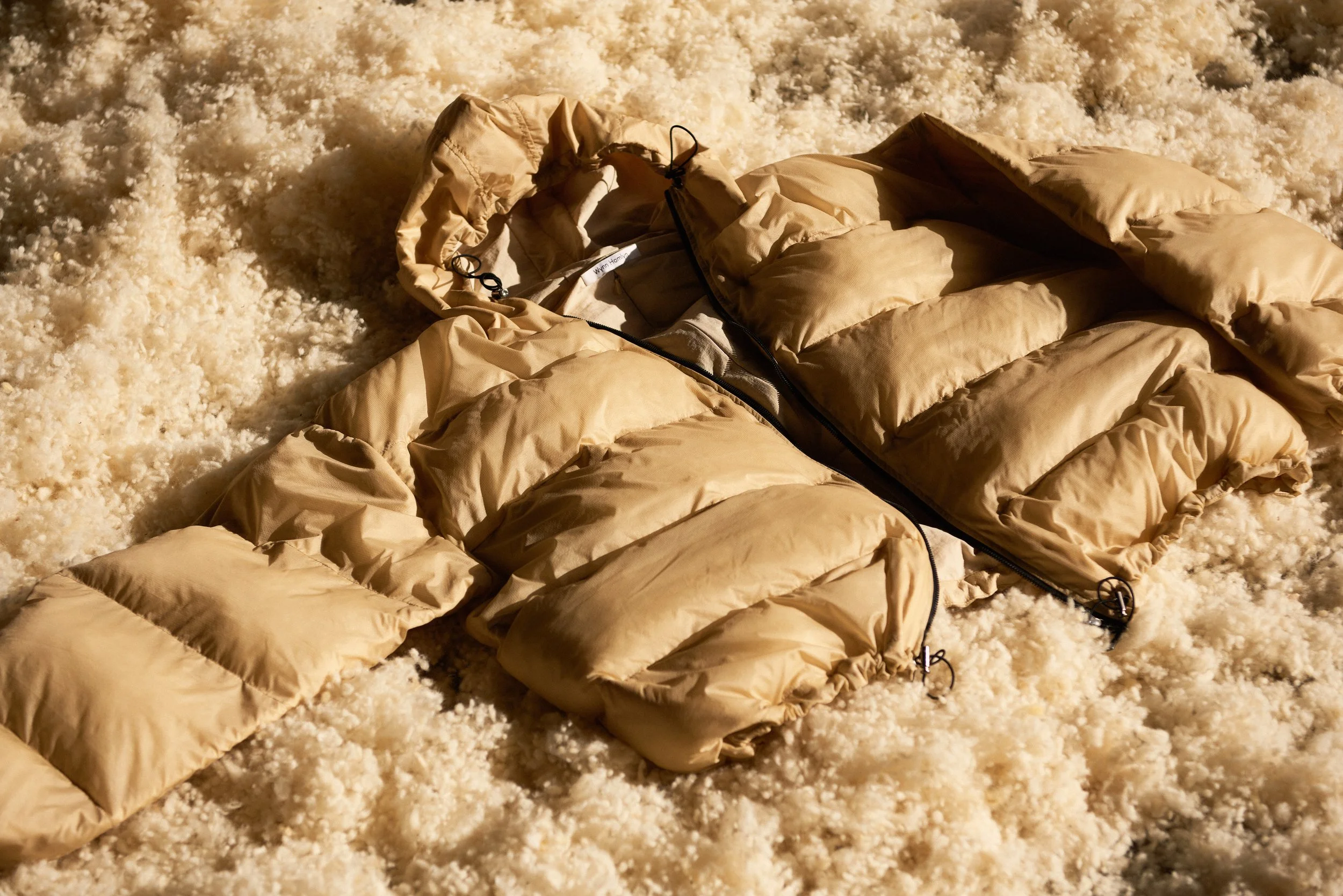
A wool puffer from Wynn Hamlyn, embracing wool as an alternative to Polyester
Dynamic Breathability: The True Test of Comfort
Real-world comfort is captured by dynamic breathability, which accounts for sweat, body movement and time. Key factors include:
Moisture management: Absorbing and releasing sweat.
Loft recovery: Maintaining insulating air pockets under compression.
Microclimate stability: Keeping consistent skin temperature.
Heat generation during moisture absorption: Wool releases warmth as it buffers humidity.
Polyester moves moisture quickly but does not buffer it, leading to condensation, collapsed insulation and a “clammy” sensation. Wool actively stabilises temperature and moisture, creating comfort that synthetics cannot replicate.
Wool vs Polyester in Puffers
High-loft jackets highlight wool’s advantages: low airflow and variable activity levels demand insulation that manages moisture and maintains loft.
Polyester: Fast but Limited
Vapour passes through but is unmanaged.
Condensation reduces insulation efficiency.
Comfort declines rapidly during stop-and-start activity.
Merino Wool: Soft and Reliable
Absorbs up to 35% of moisture by weight.
Releases heat during absorption.
Maintains loft and microclimate stability.
Strong Wool: The High-Loft Champion
Coarser fibres and higher loft enhance air retention.
Superior moisture buffering.
Excellent thermal stability even when damp.
Predicted Dynamic Breathability Ranking (Woolmark-Aligned):
| Rank | Material | Dynamic Performance |
|---|---|---|
| 1 | Strong Wool | Outstanding thermal stability; very high moisture buffering; best warmth retention |
| 2 | Merino Wool | High moisture buffering; stable warmth; excellent wearer comfort |
| 3 | Polyester | Moderate to low; fast drying but no buffering; prone to cooling spikes |
How Wool Achieves Comfort
Wool’s comfort comes from its unique fibre structure and hygroscopic nature:
Moisture absorption: Keeps you dry without feeling wet.
Heat of sorption: Releases warmth as it absorbs moisture.
Loft recovery: Maintains insulating air pockets after compression.
Microclimate stabilisation: Prevents temperature swings around the skin.
This adaptive behaviour makes wool ideal for high-performance clothing, bedding and outdoor gear.
Debunking Misconceptions
“Polyester is warmer.” Lab tests measure static conditions, ignoring wool’s dynamic properties.
“Fine fibres are always better.” Wool’s crimp and hygroscopic nature create superior thermal regulation despite coarser fibres.
“Wool is scratchy or bulky.” Modern Merino wool is soft, breathable and high-lofted, while strong wool provides excellent insulation in jackets.
Why Wool Wins in Real Life
Puffer jackets rely on trapped air for insulation. Wool enhances this system by:
Maintaining loft and insulating air pockets.
Buffering moisture to prevent condensation and chill.
Stabilising temperature through moisture-driven heat release.
Wool turns insulation from a passive barrier into a dynamic, responsive system that reacts intelligently to the wearer’s body and environment.
"Wearing wool isn’t just about warmth, it’s about a fabric that listens to your body and adjusts in real time. Wool maintains thermal comfort across both activity and rest phases, reducing the ‘after-chill’ commonly experienced in synthetic performance fabrics.”- Nicky Hansen
Conclusion
Wool’s comfort is more than a sensation; it’s science in nature. While polyester may shine in static lab tests, wool dominates in dynamic, real-world conditions. Its moisture buffering, loft recovery, and microclimate stabilisation make it ideal for garments, bedding and insulation systems.
Whether in high-loft puffer jackets, sweaters, or bedding wool doesn’t just insulate, it adapts, stabilises, and supports. That is why wool remains nature’s ultimate comfort fibre.
Author bio: Harry Urquhart-Hay is Co-Founder of Wisewool, a fifth-generation New Zealand strong wool company. Wisewool controls the wool journey from 250+ partner farms in Gisborne through to finished product, and is currently conducting a three-year MPI-funded clinical sleep science study.